

Target Audiences
- Academic Institutions (universities, colleges, etc.)
- National Agricultural Research System (NARS)
- Non-Governmental Organizations (NGO)
- Government
- Advanced Research Institutions
- Private Sector
- International Development Organizations (including Development Projects)
- Other
Organized by
Partners
EXECUTIVE SUMMARY
Name of the project
Soil Health Monitoring and Information Systems for Sustainable Soil Management in the Mediterranean Region
Purpose of the project
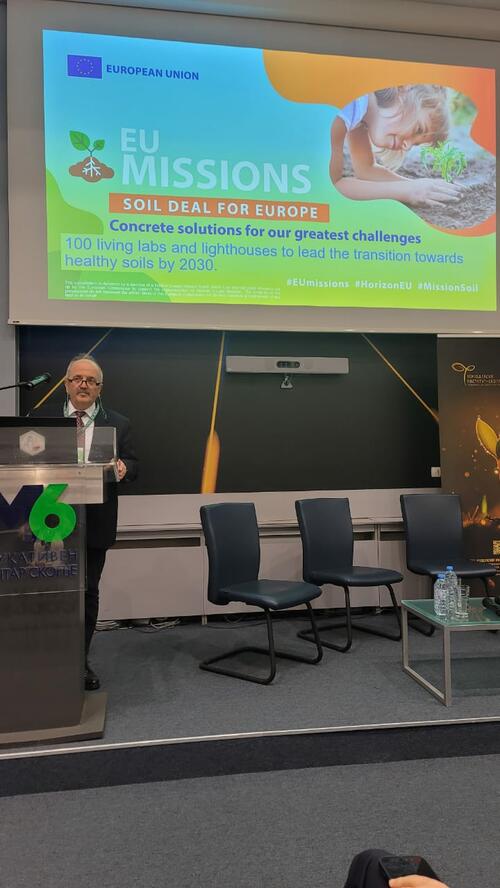
In line with the principles of the EU Mission A Soil Deal for Europe, SOILS4MED will engage a large platform of scientists, stakeholders and final users in the co-design of scientifically sound, sustainable, and policy-relevant integrated soil health monitoring systems harmonized across the Mediterranean region and will demonstrate the multiple societal benefits deriving from increased investment in soil data and information.
The specific objectives are:
1. Engage SHs in line with a Living Lab and Use Case approaches: enhance their capacities and awareness on the benefits deriving from increased investment in SDI, and secure policy relevance of the SEH indicator sets and long-term sustainability of the soil information systems (SIS).
2. Develop integrated indicator sets and a LUCAS-inspired soil monitoring protocol, adapted to the environmental specificities and SH needs of the MR, for region-wide harmonized assessment of soil ecosystem health (SEH), starting from a review of existing SDI, current monitoring systems, and SH needs.
3. Implement the monitoring protocol in study areas representing major agroecological regions and soil types of the MR and generate the first ever large, harmonized, SEH open access dataset for the MR.
4. Demonstrate the capacity of the SDI produced by the protocol, integrated by legacy data, to feed state of art DSS tools for SSWM and LDN, precision farming and other tools for rational water and nutrient management, and to support improved mapping of soil degradation, C-stock, and C-seq. potential.
5. Design and implement country-owned standardized soil information systems (SIS) for the effective protection, management, update, visualization, use, and controlled sharing/publication of the SDI.